ADE · Augmented Digital Evolution
What we are investigating
Last updated: November 2026.
In short
AI capability is fragmenting across models, agents, sensors and data. As these systems work together, risk moves from individual models to what is shared, remembered and passed between them. Principles alone have not closed that gap. We hypothesize that structural integration, with ethics and governance built into the architecture from the start, can narrow it. ADE distinguishes security, alignment, ethics and governance and examines how they interact. It treats provenance as a first class requirement, preserves human autonomy through plural futures that show their uncertainty, and keeps its functions and principles explicit as its technologies change. None of these principles is new on its own. Our claim is that their integration may produce more trustworthy and accountable systems. Phase I tests the architecture and its provenance structure.
What we mean by structure
In ADE, structure means six concrete elements:
Function contracts. Every component declares what it does, what it needs and what it guarantees.
Provenance records. Every claim carries its origin, its links to other sources, its confidence and its contradictions.
Decision rights. It is explicit who may change what. No single party can change the ethical core, and the human has the last word.
Decision records. The system keeps what it showed, what the person chose, and why.
Memory rules. What is kept, for how long, with whose consent, and how it is deleted.
Conformance. Nothing joins, changes or leaves the system without passing the same tests.
1. Ethics and governance from the first line
Ethics is normative; architecture is technical. ADE connects them through mechanisms that can be inspected: constraints on what the system may never do, rules for resolving conflicting goals, the right to contest an output and see its basis, audit trails, explicit decision rights, and the evaluation of every path against the people it affects before it is proposed. Design thinking is the method that produces them.
We use four lenses: security, alignment, ethics and governance. They overlap. A hidden instruction inside a document is a security breach and an alignment failure at once. Asking whether a system does what was intended raises the ethical question of whose intentions count. Asking what is right raises the governance question of who decides. The lenses are useful only if we study where they meet.
2. Structure within structure
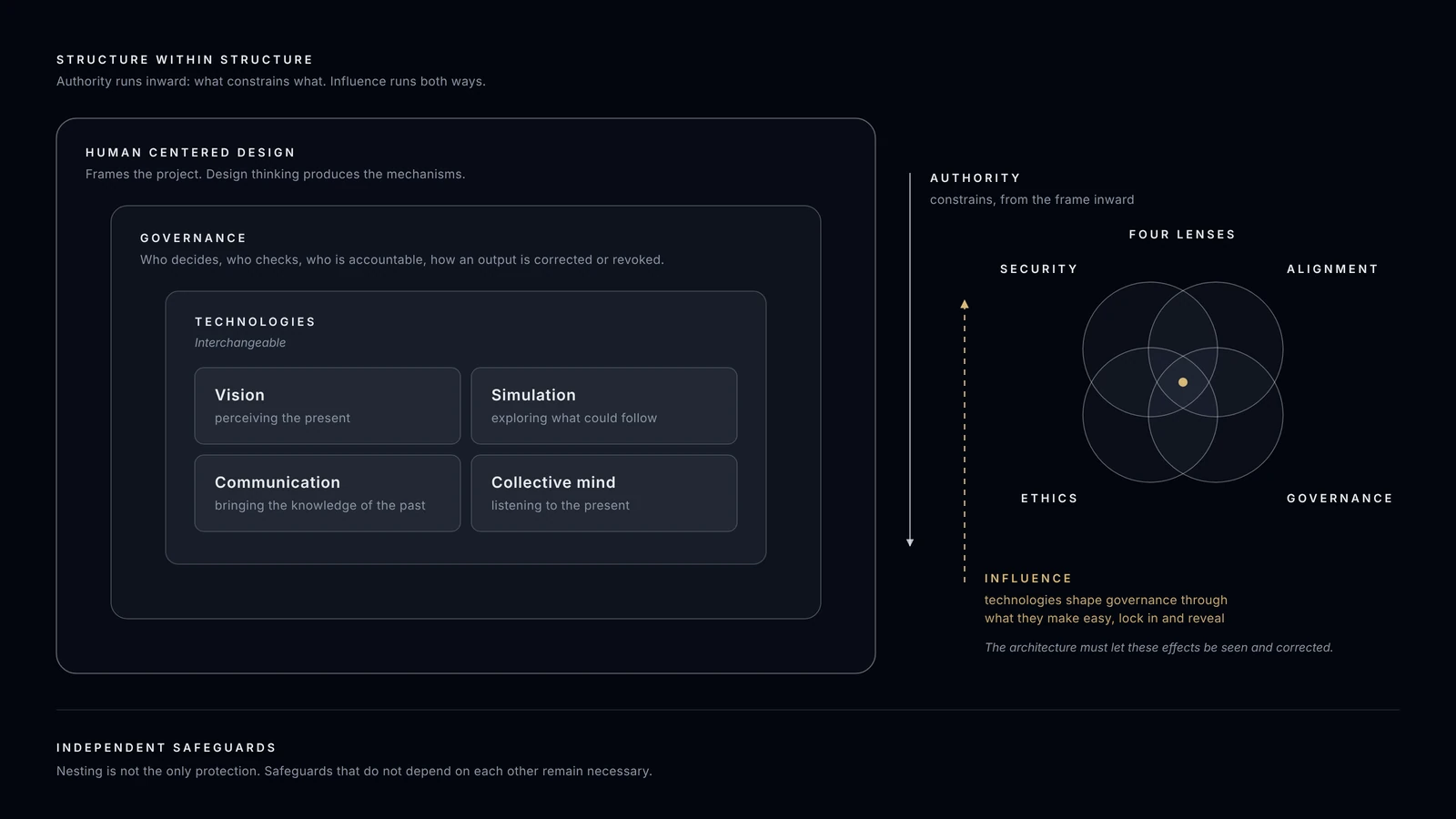
Human centered design frames the project. Governance sits inside that frame, and every technology sits inside governance. This describes authority: what constrains what. It does not describe influence, which runs both ways. Technologies shape governance through what they make easy, what they lock in and what they reveal, and the architecture must let those effects be seen and corrected. Nesting is also not the only protection. Independent safeguards that do not depend on each other remain necessary.
3. Provenance
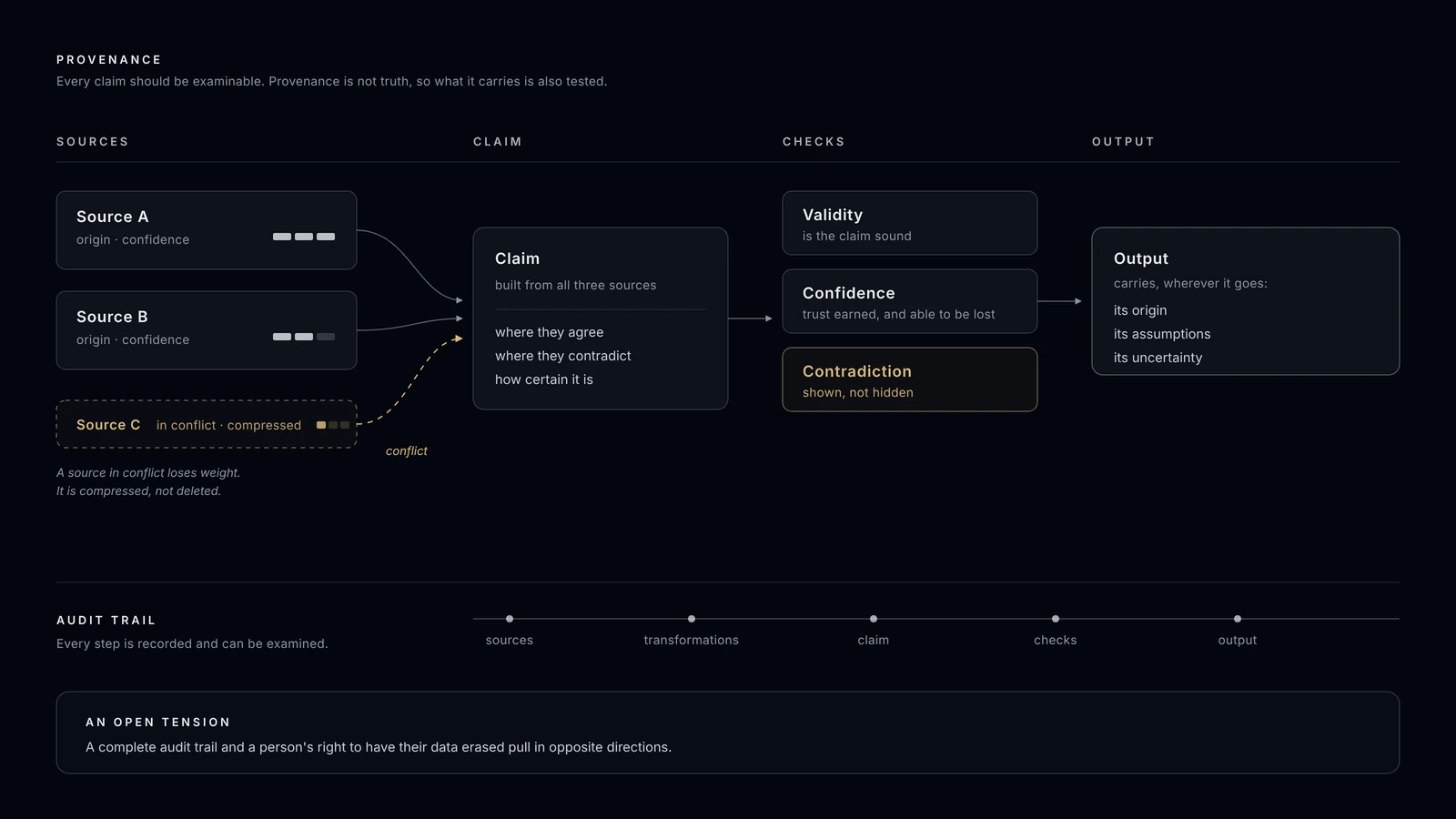
Every claim should be examinable: where it came from, how it relates to other sources, where they agree and where they contradict, and how certain the system is. Provenance is not truth. A poisoned memory can have a perfectly clear origin. So provenance is paired with validity checks, with trust in sources that is earned and can be lost, and with rules for consent and deletion. A source in conflict loses weight; it is compressed, not deleted. It also makes a system auditable: the EU AI Act requires high risk AI systems to record events automatically over their lifetime and to allow effective human oversight, obligations that apply from December 2027. One tension stays open. A complete audit trail and a person's right to have their data erased pull in opposite directions.
4. Human autonomy
ADE distinguishes exploration from decision. When exploring, it shows several possible futures, their consequences and their uncertainty, because the most probable future is not always the preferable one. When a decision is made, it belongs to the person, and its record supports accountability. How the futures are presented matters. Research shows that persuasive explanations can increase acceptance of an AI's recommendation even when it is wrong, and that what is shown first anchors the decision. We are investigating ways to present futures that inform rather than persuade, such as asking for the person's goals before showing the paths, and showing what each path depends on.
5. An architecture that evolves
Models, agents, sensors and, later, new kinds of processors will be added and replaced. Keeping functions and principles explicit is necessary, an idea as old as modular design, but it is not enough. Evolution also needs versioning, migration, the ability to revoke a component, conformance tests, and continuity of accountability when parts are replaced.
How we will know
Integration delivers if, compared with the same technologies used separately:
- every claim in an output can be traced to its sources;
- contradictions between sources are shown, not hidden;
- plural futures prove better calibrated than a single model's answer;
- people stay critical: using ADE does not make them accept its suggestions more readily when it is wrong;
- a component can be replaced without losing the record of past decisions;
- no single party can change the ethical core.
What is new, and what is not
None of these principles is new on its own. Modularity, provenance, human oversight, ethics by design and plural futures each have decades of work behind them. What ADE proposes is their integration into one architecture, organized around the human and designed to keep its principles as its technologies evolve.
Inspired by nature
Nature has spent hundreds of millions of years evolving intelligence, under constraints very different from ours. When we imagined the computer that comes next, the reference was immediate: the brain. It never relies on a single source. It combines noisy senses, weighs each by how reliable it is, spreads memory across the whole, and recombines what it has learned to imagine what has not happened yet.
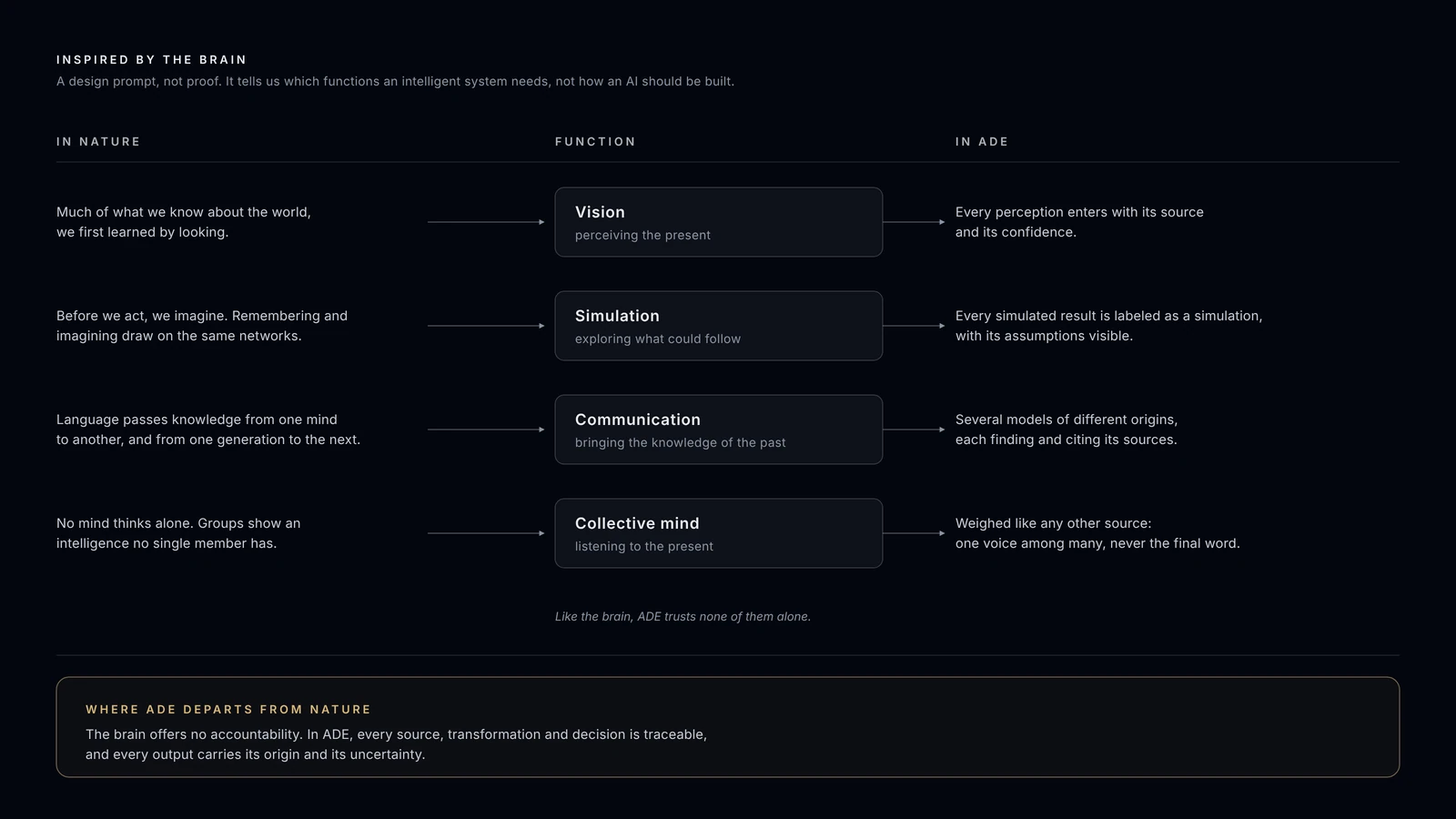
We use the brain as a design prompt, not as proof. It tells us which functions an intelligent system needs, not how an AI should be built. ADE maps four of them onto its stack: vision, simulation, communication and collective mind. Each is a function, defined by what it must deliver. None is trusted alone, and the technology behind each one can be replaced when another serves the function better.
The goal
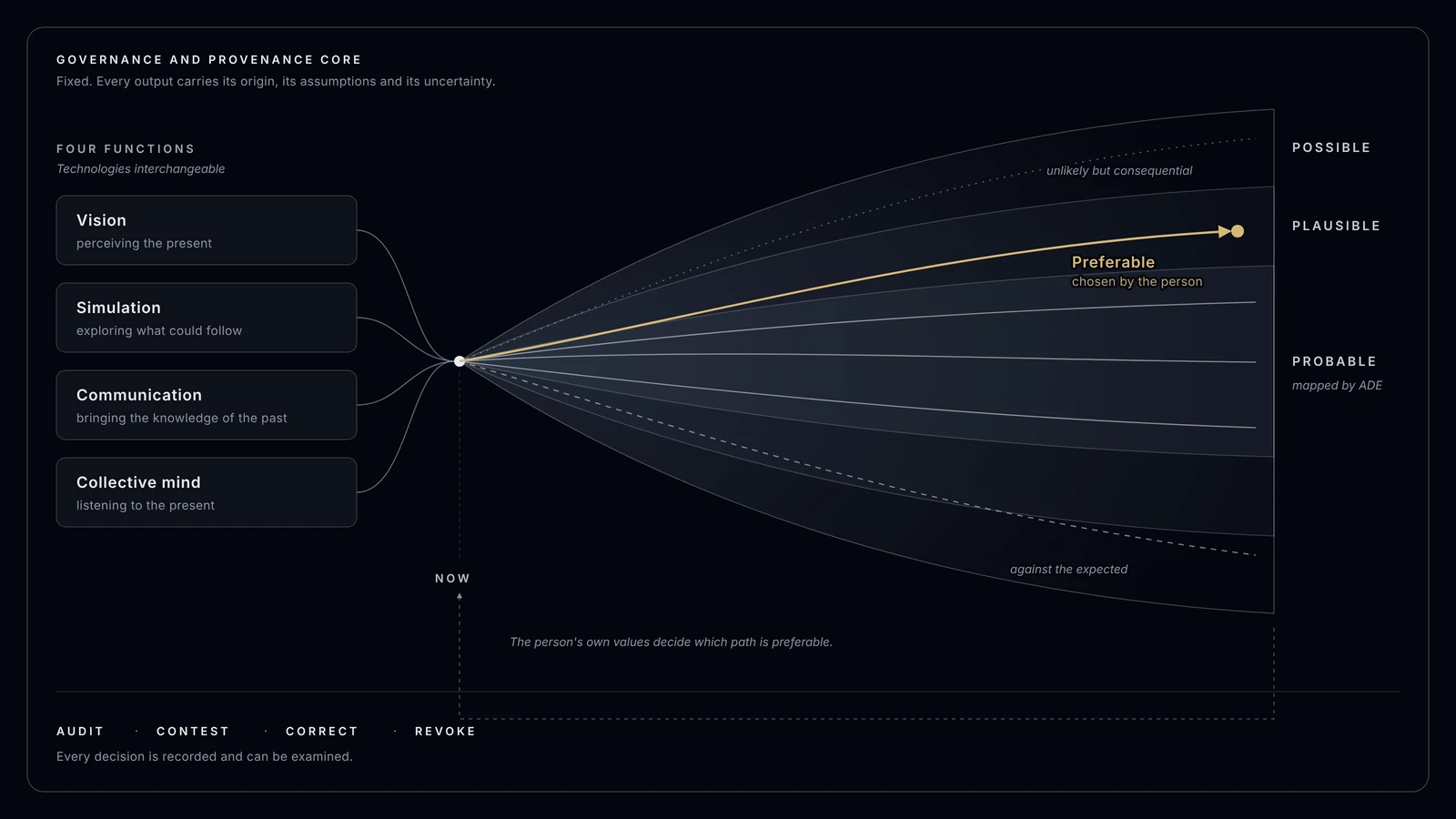
Every choice in this stack serves one goal: to explore several paths for a decision, always including one that runs against the expected and one that is unlikely but consequential, examine the consequences of each, and make an informed choice.
To do that, a system needs four things. It must perceive the present, explore what could follow, draw on what is already known, and hear what is changing right now. That is why our stack has four functions, and why each technology in it was chosen. ADE maps the possible, the plausible and the probable. The human chooses the preferable.
Two kinds of values meet here. The first never changes: the ethical core sets limits ADE does not cross. The second belongs to each person: their own values decide which path is preferable. ADE does not merge them into a single score; it shows each path against each value, and the person weighs them.
Our stack
Vision · perceiving the present
In the brain. Much of what we know about the world, we first learned by looking. A large share of the cortex is devoted to seeing, and from the first months of life infants learn how objects move, fall and persist by watching them.
Today. Systems that perceive the world through cameras alone now drive cars, telling a falling leaf from a plastic bag in the wind, or a child stepping into the road. The same vision is now teaching robots how the world works and how humans behave.
In ADE. Every perception enters with its source and its confidence. Perception trained for driving may not transfer to other domains; how far it does is an open question.
Simulation · exploring what could follow
In the brain. Before we act, we imagine. The mind carries a small model of the world and uses it to test alternatives before committing to one, an idea first described in 1943. Remembering the past and imagining the future draw on the same networks.
Today. World models recreate an environment so that a decision can be tested before it is taken. Agents placed inside these simulated worlds play the roles of people, organizations or markets, and can already reproduce some human behavior. Reproducing is not yet predicting.
In ADE. Around the simulation, specialized models turn raw information into structure, make decisions with a stated confidence, and forecast in ways that can be checked. Every simulated result is labeled as a simulation, with its assumptions visible. Every future starts from history: data, base rates, what has already happened.
Communication · bringing the knowledge of the past
In the brain. Language is how knowledge passes from one mind to another, and from one generation to the next. It is why knowledge accumulates instead of starting over.
Today. Language models open a vast body of written knowledge. They are not databases: they can be wrong with confidence.
In ADE. We use several models of different origins, because models trained on similar data can share the same mistakes, and each must find and cite its sources. Above them, a layer of agents routes questions, divides the work and returns the results. Every agent works within defined limits, because many agents create risks no single agent has: miscoordination, collusion and errors that cascade.
Collective mind · listening to the present
In groups. No mind thinks alone. Groups can show a collective intelligence that no single member has, and many independent judgments, combined, are often closer to the truth than most individual guesses.
Today. A live public conversation brings research, opinions corrected by the crowd, and the first signs of emerging companies, technologies and ideas.
In ADE. It is also uneven, manipulable and inconsistently corrected. So it is weighed like any other source: one voice among many, never the final word.
Together
Vision shows the present. Simulation explores what could follow. Communication brings the knowledge of the past. The collective mind adds what people see and say right now. Like the brain, ADE trusts none of them alone. But the brain offers no accountability, and this is where ADE departs from nature. Provenance, audit and governance are first class requirements: every source, transformation and decision is traceable, every agent works within limits, and every output carries its origin and its uncertainty. Governance states who decides, who checks, who is accountable, and how an output is corrected or revoked. That is what turns many inputs into an examinable structure of outputs.
And it raises the question that led us to 3 Sphere: how do we organize all of it? 3 Sphere organizes it, keeping relationships, context and history together.
We design from the whole system, never from a single part. Built around the human, for a complexity that's ever evolving.
Different goal, different stack
The stack changes with the result each person is looking for. Start from that result, then research which technologies fit it. You choose what goes in. When another technology delivers a better result, it takes its place. The technologies are interchangeable.
A city planner. Street sensors and satellite imagery perceive the present. Public data and local news bring what is changing. A simulated city, with agents as residents and traffic, explores what could follow. The result: the possible futures of a neighborhood, before a single street changes.
A health researcher. Data from wearables perceives the present. Medical literature brings what is already known. Simulated patients explore what could follow. The result: the possible outcomes of a treatment, to generate hypotheses before the first trial, never to replace trials or ethical review.
Build
Phase I · Classical. ADE takes shape as software that connects and orchestrates today's technologies: an environment where models, agents and memory work together.
Phase I proves the idea. Phases II and III are what it was built for.
Signals
Where the world is already heading. Each signal shows direction, not proof of our architecture.
- Cars see and simulate the world with cameras and one neural network. 2025. In production.
- AI agents simulate 1,000 real people, replicating their answers 85% as accurately as the people themselves two weeks later. 2024. Published.
- An open standard connects any AI to any tool. 2025. Adopted.
- AI results that anyone can reproduce and verify. 2026. Emerging.
- Twelve AI models, combined, forecast real events as accurately as a crowd of 925 human forecasters. 2024. Peer reviewed.
- A team of AI agents, one leading and others researching in parallel, outperformed a single agent by 90% on research tasks. 2025. Reported by the developer.
- AI assistants now remember people across all their past conversations. 2025. In production.
- Cameras and phones now sign where an image came from, using an open provenance standard. 2025. In production.
- A whole city has a digital twin, used to test plans before they are built. In use.
- A regulator plans to replace part of animal testing with computational models. 2025. Announced.
- Europe writes record keeping and human oversight into law for high-risk AI. 2024. Adopted; applies from December 2027.
References
References are listed by section; each section's sources support its empirical claims.
What we are investigating
- Hammond et al. (2025), Multi-Agent Risks from Advanced AI, Cooperative AI Foundation. https://arxiv.org/abs/2502.14143
- Alignment of Complex Systems Research Group, Charles University. https://acsresearch.org/about
- Mittelstadt (2019), Principles alone cannot guarantee ethical AI, Nature Machine Intelligence. https://www.nature.com/articles/s42256-019-0114-4
- IEEE 7000-2021, Model Process for Addressing Ethical Concerns during System Design. https://standards.ieee.org/standard/7000-2021.html
- Friedman & Hendry (2019), Value Sensitive Design, MIT Press.
- Greshake et al. (2023), indirect prompt injection, ACM AISec. https://arxiv.org/abs/2302.12173
- Reason (2000), Human error: models and management, BMJ.
- Chen et al. (2024), AgentPoison, NeurIPS. https://arxiv.org/abs/2407.12784
- EU AI Act, Article 12 (record keeping) and Article 14 (human oversight). https://artificialintelligenceact.eu/article/12/
- Regulation (EU) 2026/1744 (Digital Omnibus on AI), deferring high-risk obligations to December 2027. https://eur-lex.europa.eu/eli/reg/2026/1744/oj/eng
- GDPR, Article 17 (right to erasure).
- Voros (2003), A generic foresight process framework, Foresight 5(3).
- Bansal et al. (2021), Does the Whole Exceed its Parts?, CHI. https://dl.acm.org/doi/fullHtml/10.1145/3411764.3445717
- Parnas (1972), On the criteria to be used in decomposing systems into modules, CACM. https://dl.acm.org/doi/10.1145/361598.361623
- Brier (1950), Monthly Weather Review; Mellers et al. (2014), Psychological Science.
Inspired by nature
- The deep evolutionary roots of the nervous system (2025). https://pubmed.ncbi.nlm.nih.gov/40198851/
- Balasubramanian (2021), Brain power, PNAS. https://pmc.ncbi.nlm.nih.gov/articles/PMC8364152/
- Ernst & Banks (2002), Nature. https://www.nature.com/articles/415429a
- Teyler & DiScenna (1986), hippocampal memory indexing theory. https://pubmed.ncbi.nlm.nih.gov/3008780/
- Simon (1962), The Architecture of Complexity.
Our stack
- Vision: Felleman & Van Essen (1991), Distributed hierarchical processing in the primate cerebral cortex, Cerebral Cortex; Spelke & Kinzler (2007), Core knowledge, Developmental Science; Elluswamy, Tesla's approach to autonomy, ICCV 2025.
- Simulation: Craik (1943), The Nature of Explanation; Schacter & Addis (2007), The cognitive neuroscience of constructive memory, Philosophical Transactions of the Royal Society B; Stanford HAI, Simulating Human Behavior with AI Agents; Mellers et al. (2014).
- Communication: Tomasello (1999), The Cultural Origins of Human Cognition; Kalai et al. (2025), Why Language Models Hallucinate; Du et al. (2023), multiagent debate; Smit et al. (2024), ICML; Hammond et al. (2025).
- Collective mind: Woolley et al. (2010), Evidence for a collective intelligence factor in the performance of human groups, Science; Galton (1907), Vox populi, Nature; studies of crowd sourced fact checking on X (Community Notes).
Public block
- Atomically thin transistors and silicon's physical limits (TechXplore, Oct 2026).
- IEA, Energy and AI (2025).
Signals
- Tesla, ICCV 2025; Stanford HAI (2024); Agentic AI Foundation and the Model Context Protocol (2025); Gensyn, REE (2026).
- Schoenegger et al. (2024), Wisdom of the silicon crowd: LLM ensemble prediction capabilities rival human crowd accuracy, Science Advances. https://www.science.org/doi/10.1126/sciadv.adp1528
- Anthropic (2025), How we built our multi-agent research system. https://www.anthropic.com/research/multi-agent-research-system
- OpenAI (April 2025), memory in ChatGPT references all past conversations.
- C2PA, Content Credentials specification 2.3. https://spec.c2pa.org/specifications/specifications/2.3/specs/C2PA_Specification.html
- Singapore Land Authority, Virtual Singapore (OECD Observatory of Public Sector Innovation). https://oecd-opsi.org/innovations/virtual-twin-singapore/
- FDA (2025), Roadmap to Reducing Animal Testing in Preclinical Safety Studies. https://www.fda.gov/files/newsroom/published/roadmap_to_reducing_animal_testing_in_preclinical_safety_studies.pdf
- EU AI Act and Regulation (EU) 2026/1744. https://eur-lex.europa.eu/eli/reg/2026/1744/oj/eng
3 Sphere
What we are investigating
In short
Search retrieves documents. Language models generate answers. Neither is designed to keep the shape of how things connect, or how that shape came to be. 3 Sphere investigates a way of organizing information in which relationships, context and history are kept together, so that a question can be explored from the path that led to the present. 3 Sphere is in active research, with a first prototype. 3 Sphere is an independent project that can operate on its own or alongside ADE, helping organize inputs and strengthening both projects. Our hypothesis is that information organized this way supports deeper, more honest answers than information stored as isolated records.
The problem
Three things are lost when information is stored as separate pieces. Relationships: a fact about a company means little without its partners, its markets and its people. History: the same situation, reached by different paths, can lead to different futures, because small past events are not averaged away. And honesty: AI systems often answer questions that do not contain enough to be answered, because they are trained and evaluated in ways that reward guessing over admitting uncertainty.
What 3 Sphere is designed to do
It keeps together what other systems separate: how things connect, the context in which they are seen, and how they came to be. When a question does not contain enough to be answered, it does not guess; it asks for more. When it explores what could happen, it shows how uncertain that is. And it looks for connections between fields that are usually studied apart. This is where its value should be greatest, and where it is hardest to prove. Every claim is tested against the same information stored the conventional way.
What is new, and what is not
Many ways of storing and analyzing information exist, and 3 Sphere builds on them. What it proposes is a different way of organizing information, designed around questions that cross fields, where openness, history and the refusal to guess are features rather than limitations.
References
- Arthur, W. B. (1989). Competing Technologies, Increasing Returns, and Lock-In by Historical Events. The Economic Journal. https://fbaum.unc.edu/teaching/articles/Arthur_EJ_1989.pdf
- Kalai, A. T., et al. (2025). Why Language Models Hallucinate. arXiv. https://arxiv.org/abs/2509.04664
HCY · Human Computer Symbiosis
What we are investigating
In short
As ADE grows more capable, the limit moves from the computer to the person working with it. HCY, Human Computer Symbiosis, investigates a way of working in which the person sets the direction and ADE carries the work: it remembers, divides, compares and returns, without asking for attention it was not given.
An idea older than us
Our work may look new. It rests on ideas older than we are.
In 1945, Vannevar Bush imagined a desk that would store everything a person reads and link it by association, a supplement to human memory. In 1960, J. C. R. Licklider proposed what he called man-computer symbiosis: people set the goals, formulate the hypotheses, choose the criteria and make the evaluations, while the computer does the routine work that prepares the way for insight and decision. In 1962, Douglas Engelbart called for technology that augments human intellect instead of replacing it.
What has changed is the computer. For the first time, a computer can perceive, simulate, remember and act on its own initiative. The partnership these pioneers described is no longer a thought experiment. It is a design problem, and an urgent one.
The problem: human attention becomes the constraint
Using AI today often requires people to translate what they mean into prompts a model can interpret. This is difficult without specialist experience, and even detailed prompts can leave important requirements unstated. Adding more words alone does not resolve the problem.
ADE’s proposed architecture adds another challenge. Perception, simulation, language models from different sources, and coordinating agents may work in parallel and initiate work. A person cannot reasonably track every process and result. ADE is intended to manage that coordination.
This makes human direction and judgment more important. The person should set goals, resolve consequential ambiguities, and evaluate outcomes, while ADE handles the translation and coordination needed to carry out the work.
Why ADE needs it
A system with many models and no direction produces more, not better. The person decides the question, the project it belongs to and what counts as a good answer. ADE divides the work, compares what comes back, shows where the sources disagree and returns one picture that can be examined. Direction is what turns parallel work into research.
What the symbiosis requires
A memory of its own. ADE will have its own memory, so it will remember the person: their projects, what was decided and why, how they think. People have wanted a second brain since the desk Bush imagined. With it, a request can be spoken the way one speaks to a colleague, unfinished and out of order, and still be understood.
Grounding requests in context. Language alone can be imprecise when identifying the subject of a request. A person should be able to mark a passage, say “research this,” and continue working. The marked passage identifies the subject; the instruction specifies the action. Looking at something must never trigger an action on its own, since attention does not imply intent.
Returning results at the right time. Results should reach the person when they can review them, with a clear link to the original request. They should present the key findings first, make uncertainty explicit, and identify any decisions that require the person’s judgment. Delegation should allow someone to step away without having to monitor progress.
Voice, visual context, and future interfaces
The way people work should determine which channels ADE uses. Voice is available today. Visual context is the next proposed channel: glasses could indicate what a person is looking at, although gaze alone does not establish intent. Neural input remains a longer-term research direction. Non-invasive systems have demonstrated limited reconstruction of meaning from brain activity under controlled laboratory conditions and with the participant’s cooperation. Each channel should complement the others, while ADE remains open to future interfaces. The devices themselves are developed by others.
How we will know
Compared with working through prompts and screens, ADE should enable people to:
- make requests in their own words without repeatedly reformulating them;
- delegate work without continuous monitoring and receive results at a time they can review them;
- inspect and correct ADE’s interpretation before it acts;
- spend more attention on direction and judgment than on coordinating models;
- understand the results well enough to question and evaluate them.
ADE must act only with the person’s authorization.
What ADE proposes
Human-computer symbiosis is an established idea. Voice interfaces, eye tracking, and assistants with memory also exist. ADE’s proposed contribution is to bring these capabilities into a coherent way of working with a proactive, multi-model system that can present possible outcomes rather than a single answer. The design starts with the person’s direction, attention, and control.
References
- Bush, V. (1945). As We May Think. The Atlantic Monthly.
- Licklider, J. C. R. (1960). Man-Computer Symbiosis. IRE Transactions on Human Factors in Electronics.
- Engelbart, D. (1962). Augmenting Human Intellect: A Conceptual Framework. Stanford Research Institute.
- Zamfirescu-Pereira, J. D., et al. (2023). Why Johnny Can't Prompt: How Non-AI Experts Try (and Fail) to Design LLM Prompts. Proceedings of CHI 2023. https://dl.acm.org/doi/10.1145/3544548.3581388
- Yang, C., et al. (2026). What Prompts Don't Say: Understanding and Managing Underspecification in LLM Prompts. Findings of ACL 2026. https://aclanthology.org/2026.findings-acl.441/
- Cowan, N. (2001). The Magical Number 4 in Short-Term Memory: A Reconsideration of Mental Storage Capacity. Behavioral and Brain Sciences.
- Bainbridge, L. (1983). Ironies of Automation. Automatica.
- Khan, A. A., et al. (2026). Gaze and Speech in Multimodal Human-Computer Interaction: A Scoping Review. Proceedings of CHI 2026. https://dl.acm.org/doi/10.1145/3772318.3791662
- Prasov, Z., & Chai, J. Y. (2008). What's in a Gaze? The Role of Eye-Gaze in Reference Resolution in Multimodal Conversational Interfaces. Proceedings of IUI 2008.
- Jacob, R. J. K. (1990). What You Look At Is What You Get: Eye Movement-Based Interaction Techniques. Proceedings of CHI 1990.
- Mark, G., Gudith, D., & Klocke, U. (2008). The Cost of Interrupted Work: More Speed and Stress. Proceedings of CHI 2008.
- Horvitz, E. (1999). Principles of Mixed-Initiative User Interfaces. Proceedings of CHI 1999.
- Amershi, S., et al. (2019). Guidelines for Human-AI Interaction. Proceedings of CHI 2019.
- Ruan, S., et al. (2018). Comparing Speech and Keyboard Text Entry for Short Messages in Two Languages on Touchscreen Phones. Proceedings of the ACM on Interactive, Mobile, Wearable and Ubiquitous Technologies.
- Just, M. A., & Carpenter, P. A. (1980). A Theory of Reading: From Eye Fixations to Comprehension. Psychological Review.
- Tang, J., et al. (2023). Semantic Reconstruction of Continuous Language from Non-Invasive Brain Recordings. Nature Neuroscience. https://www.nature.com/articles/s41593-023-01304-9
- Oviatt, S. (1999). Ten Myths of Multimodal Interaction. Communications of the ACM.